RoadDrive
AboutApp StoreSign In / Up

The Jungle Highway to Iguazu Falls

The Jungle Highway to Iguazu Falls
Posadas
Puerto Iguazú
Argentina
364 km
6h 7m

Jesuit Ruins and Jungle Roads to the Falls

Ruta Nacional 12 runs northeast from Posadas through the heart of Misiones — a narrow finger of Argentine territory wedged between Paraguay and Brazil, covered in some of the last remaining Atlantic Forest on Earth. This is subtropical Argentina: red laterite earth, towering jungle canopy, yerba mate plantations, clouds of butterflies, and toucans calling from the treetops.

Within an hour of Posadas, the red sandstone ruins of San Ignacio Miní appear — a UNESCO-listed Jesuit mission where two priests and 4,500 Guaraní once built a self-governing community with a printing press, an orchestra, and Baroque stone carvings. North of the ruins, the forest thickens. The highway passes orchid nurseries at Montecarlo, yerba mate hillsides around Eldorado, and glittering amethyst mines at Colonia Wanda.

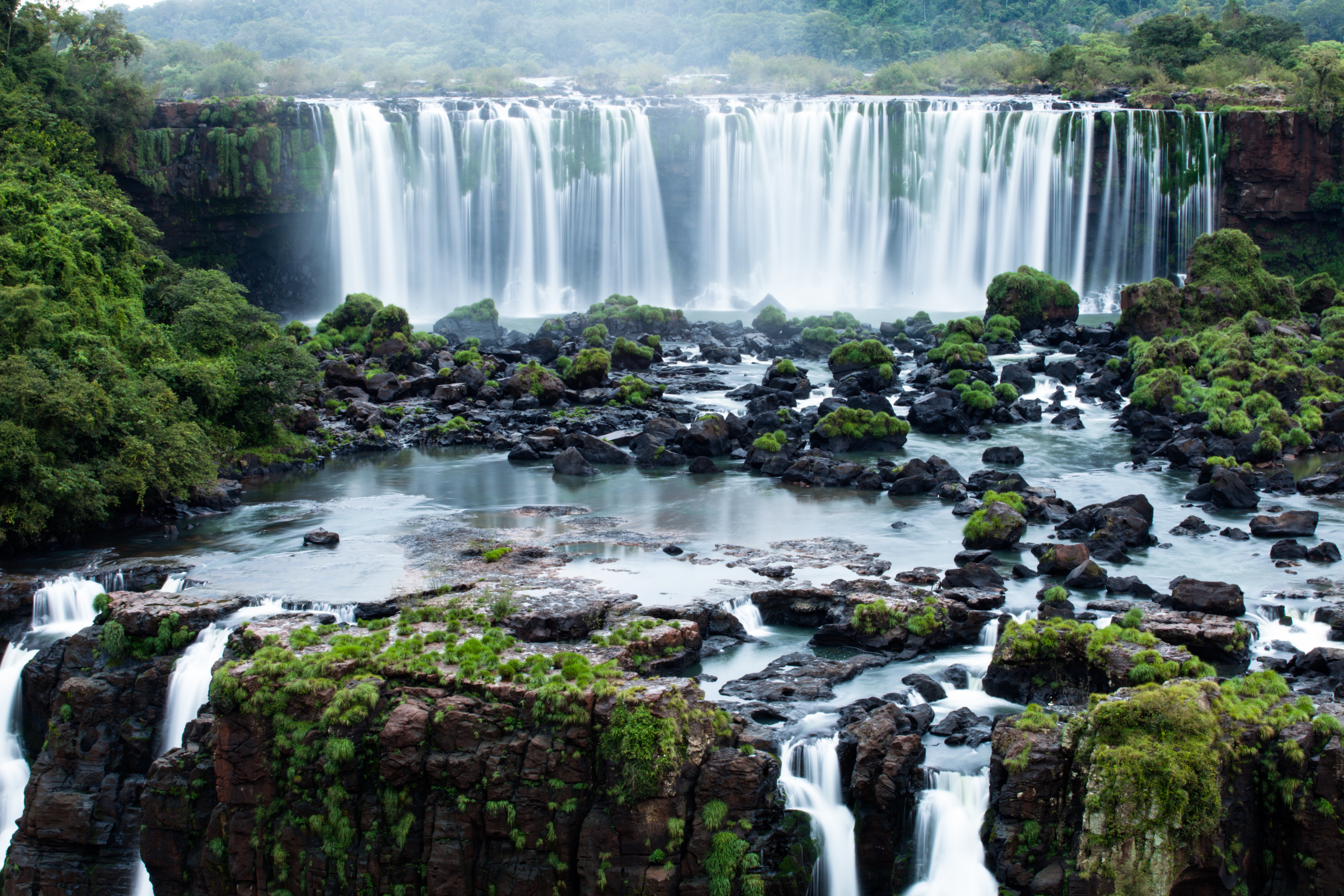
The final approach pushes through dense jungle to the confluence of the Iguazú and Paraná rivers, where three nations meet. And 18 km from Puerto Iguazú, the forest parts to reveal 275 waterfalls crashing over a 2.7 km basalt ledge — taller than Niagara and nearly three times as wide. The Devil's Throat, an 82 m curtain of white water pouring into a roaring chasm of permanent mist and rainbows, is the kind of sight that rearranges your sense of scale.


Key Stops

Posadas The capital of Misiones Province (pop. ~350,000), sprawling along the south bank of the Paraná River. Across the water, connected by the 2,550 m San Roque González de Santa Cruz Bridge, lies Encarnación, Paraguay. Posadas is a warm, unhurried city with a long riverfront costanera, a lively craft market, and the last full-service stop before the jungle begins. Fill your tank, stock up on water, and head northeast.

Santa Ana & Nuestra Señora de Loreto Two atmospheric Jesuit mission ruins flanking the highway, both part of the UNESCO World Heritage listing. Santa Ana (founded 1633, relocated 1660) once housed over 7,000 Guaraní; today dense forest reclaims the stone walls, giving it a lost-city atmosphere that San Ignacio's restored ruins cannot match. Loreto (founded 1632) is historically significant as the site of the first printing press in the entire southern half of South America. Both sites are quieter and more contemplative than San Ignacio — and included on the combined entry ticket.

San Ignacio Miní The finest Jesuit mission ruin in Argentine territory and a UNESCO World Heritage Site since 1984. Founded in 1610, relocated after Portuguese slave raids, and settled at its present site in 1696, the mission reached a population of 4,500 Guaraní under the administration of just two Jesuit priests. What survives is remarkable: the complete layout of the settlement — church, cloisters, workshops, cemetery, and rows of Guaraní dwellings arranged around a central plaza — with elaborately carved red sandstone doorways and columns in a distinctive fusion of Baroque and Guaraní art. After the Jesuits were expelled from the Americas in 1767, the mission fell into ruin and was partially destroyed in border conflicts. Restored in the 1940s, it now includes an on-site museum. An evening sound-and-light show is sometimes offered.

Casa Museo Horacio Quiroga (San Ignacio) Also in San Ignacio, the former home of Horacio Quiroga (1878–1937), the Uruguayan-Argentine writer often called the master of the Latin American short story. Quiroga built this house with his own hands and lived here from 1910, drawing inspiration from the Misiones jungle for his celebrated Cuentos de la Selva (Tales of the Jungle). The museum preserves his furniture, photographs, tools, and — in a tiny outbuilding — his typewriter and desk where he wrote. A pilgrimage for lovers of Latin American literature.

Montecarlo Known as the National Capital of the Orchid, this town was founded in 1920 by German immigrants. Private orchid nurseries (orquidearios) are open to visitors year-round, and the annual Fiesta Nacional de la Orquídea draws plant enthusiasts from across Argentina. The surrounding hillsides are carpeted with yerba mate plantations — the manicured rows of dark-leaved holly trees that produce Argentina's national beverage. Several estates along the Ruta de la Yerba Mate offer tours of the full process, from harvest to the dried, aged mate in your gourd.

Eldorado The third-largest city in Misiones, set amid red-earth farmland and remnant Atlantic Forest. A practical fuel and supply stop, and a good place for lunch. The surrounding area was colonized by European immigrants in the early 20th century, and the cultural mix — German, Scandinavian, Polish, Ukrainian — gives the town a character distinct from the rest of Argentina.

Wanda Mines At Colonia Wanda, 50 km south of Puerto Iguazú, guided tours descend into open-pit and tunnel gemstone mines where volcanic basalt cavities formed 130 million years ago are lined with glittering amethyst crystals, alongside agate (48 varieties), quartz, jasper, and topaz. The tunnels extend 300 m and reach 25 m deep; the walls sparkle purple under torch light. A gift shop sells cut and polished stones. Allow about an hour.

Puerto Iguazú A small, leafy border town (pop. ~82,000) at the confluence of the Iguazú and Paraná rivers, surrounded by dense jungle despite receiving 1.5 million tourists a year. The town has hotels, restaurants, a craft market, and a relaxed, tropical pace. Visit Güirá Oga, a wildlife rehabilitation centre for injured forest birds and animals, and La Aripuca, a giant replica of a traditional Guaraní bird trap built from recycled timber. The falls are 18 km from the town centre.

Hito Tres Fronteras A viewpoint at the meeting point of Argentina, Brazil, and Paraguay, where the Iguazú River flows into the Paraná. Each country has erected a painted obelisk on its bank in national colours. The Argentine side has a craft fair, a plaza, and a sunset water-and-light show. Free entry. The view across to both neighbouring countries — with the rivers churning below — is a powerful reminder of where you are: the very corner of three nations.

Parque Nacional Iguazú & Iguazú Falls The culmination of the drive and one of the great natural spectacles on Earth. The falls extend 2.7 km in a horseshoe of roughly 275 individual cascades plunging 60–82 m into the gorge below, with an average flow of 1,746 m³ per second. The park covers 677 km² of protected Atlantic Forest — a UNESCO World Heritage Site since 1984 and one of the New Seven Wonders of Nature.

Three trail circuits reveal the falls from every angle:

  • Upper Circuit — boardwalks along the top, looking down over the cascades
  • Lower Circuit — descends to the base of several falls, with spray drenching you from metres away. An optional boat ride reaches San Martín Island
  • Devil's Throat Trail — a 2.2 km round-trip on steel catwalks over the river to a platform at the very lip of the Garganta del Diablo, a U-shaped, 150 m-wide chasm where the greatest volume of water concentrates. The roar is deafening; a permanent cloud of mist rises hundreds of metres, generating perpetual rainbows


Driving Tips

  • Budget more time than the distance suggests. The 310 km can be driven in under 5 hours, but with the ruins, mines, and falls you need a full day — ideally two.
  • Refuel in larger towns (Posadas, Eldorado, Puerto Iguazú). Stations are frequent, but don't let the tank drop below half.
  • Phone roaming alert. Near the Paraná River, your mobile may connect to Paraguayan networks. Switch to manual network selection to avoid unexpected roaming charges.
  • Rain gear year-round. Misiones has a subtropical climate with sudden downpours in any season. Carry a waterproof jacket, especially for the falls.
  • Sunscreen and insect repellent. The humidity and heat are intense from October to March. Mosquitoes are active, particularly near water and in the forest.
  • Do not feed the coatis at Iguazú. They are habituated to tourists and will snatch food from your hands. Keep bags closed and food stowed.
  • Buy park tickets online in advance for Parque Nacional Iguazú to skip queues, especially in peak season (January, Easter, July holidays).
  • Carry cash. Some smaller attractions, roadside vendors, and rural fuel stations may not accept cards.
  • For more information visit: iguazufalls.com

Waypoints (12)

☰
1
Costanera, Posadas
⛰️ 104 m
48 km
40m
☰
2
Santa Ana Ruins
⛰️ 156 m
10 km
13m
☰
3
Nuestra Señora de Loreto Ruins
⛰️ 139 m
16 km
16m
☰
4
San Ignacio Miní
⛰️ 136 m
126 km
1h 48m
☰
5
Casa Museo Horacio Quiroga, San Ignacio
⛰️ 131 m
32 km
35m
☰
6
Vivero Ehwo Orquídeas, Montecarlo
⛰️ 177 m
6 km
11m
☰
7
Eldorado
⛰️ 181 m
52 km
45m
☰
8
Wanda Mines
⛰️ 192 m
47 km
44m
☰
9
Güirá Oga, Puerto Iguazú
⛰️ 197 m
5 km
12m
☰
10
La Aripuca, Puerto Iguazú
⛰️ 197 m
5 km
16m
☰
11
Hito Tres Fronteras
⛰️ 197 m
16 km
21m
☰
12
Parque Nacional Iguazú
⛰️ 237 m