The Andes Crossing
Thirty Switchbacks Over the Andes
Few border crossings anywhere in the world match this one for sheer drama. The Trans-Andean Highway climbs from the fertile floor of Chile's central valley into the highest reaches of the Andes, threads through a 3 km tunnel bored beneath the continental divide, then descends past the tallest peak in the Western Hemisphere into the sun-baked wine country of Mendoza.
Heading east from Santiago, Ruta 57 crosses irrigated farmland to Los Andes, the last major Chilean town before the mountains swallow the road. Beyond, Ruta 60 enters the Aconcagua river valley and begins to climb in earnest. At Portillo, the famous ski resort sits beside the impossibly blue Laguna del Inca, ringed by jagged, snow-streaked peaks. Then comes the signature spectacle — Los Caracoles, a chain of 29 hairpin switchbacks carved into the bare mountainside, zigzagging upward through nearly 600 vertical metres. Seen from above, the road scratches across the brown slopes like a seismograph trace.
At the top, the Cristo Redentor Tunnel swallows you into the mountain. You enter in Chile; you emerge in Argentina. The tiny hamlet of Las Cuevas sits just beyond the tunnel mouth, and in summer a dirt track climbs from here to the original pass and the Cristo Redentor statue, erected in 1904 to celebrate peace between the two nations.
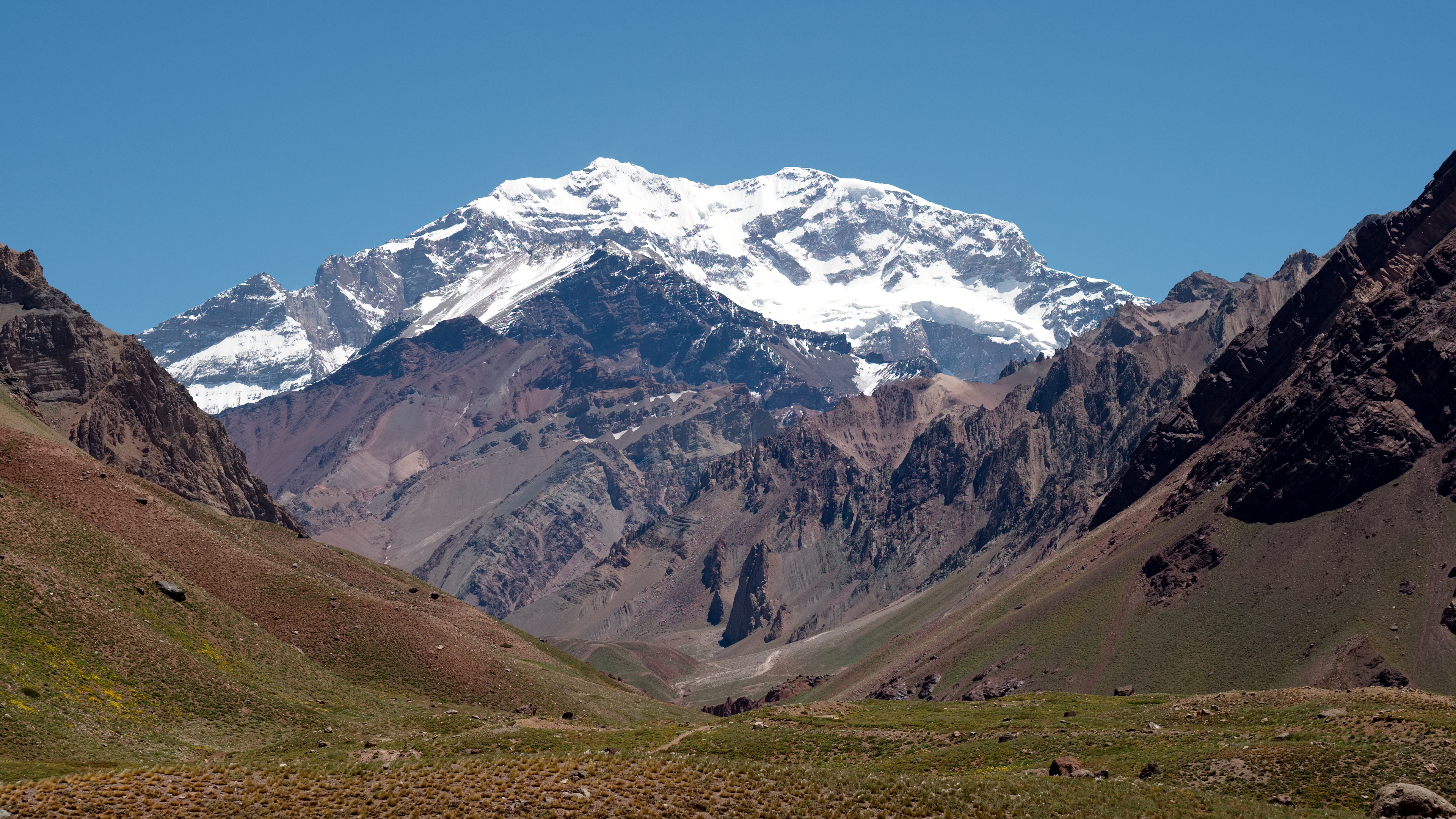
The Argentine descent is gentler but no less spectacular. At Puente del Inca, a natural rock bridge coated in vivid mineral deposits of yellow, orange, and green spans the Las Cuevas River — a geological curiosity that once hosted a grand spa hotel. Minutes later, a short trail from the Aconcagua Provincial Park entrance leads to a viewpoint of Cerro Aconcagua (6,961 m), the highest summit outside the Himalayas, its massive south face looming over the valley. The road then drops through increasingly arid canyon scenery to Uspallata, winds past the turquoise Potrerillos Reservoir, and finally flattens into the leafy avenues and vine-draped bodegas of Mendoza.
Key Stops
Santiago
Chile's capital sprawls across a broad valley ringed by Andean foothills, home to seven million people. Before heading east, fuel up and stock supplies in the outer suburbs along Ruta 57. The city itself rewards an extra day — the hilltop viewpoint of Cerro San Cristóbal offers a panorama of the skyline framed by snow-capped peaks, a preview of the mountains you are about to cross. The bohemian Barrio Lastarria and the Mercado Central (famous for its seafood) are worth a visit. The highway exits the city's northeastern edge through the satellite town of Colina and into the Aconcagua Valley farmland.
Los Andes
A prosperous agricultural town of 67,000 in the upper Aconcagua Valley — your last reliable stop for fuel, ATMs, food, and supplies on the Chilean side. The surrounding valley is a noted wine region; Viña Errázuriz and Viña San Esteban are nearby for anyone lingering before the climb.
Portillo & Laguna del Inca
Chile's most storied ski resort perches at 2,880 m on the shore of Laguna del Inca, a deep glacial lake whose intense blue colour darkens in winter when it freezes solid. The yellow hotel is unmistakable against the grey peaks. In summer the resort is closed for skiing but the lake and surrounding scenery are still dazzling — pull over for photographs.
Los Caracoles Switchbacks
The most photographed stretch of road in the Andes. Twenty-nine numbered hairpin turns climb 600 m up a sheer mountainside in roughly 6.5 km. Before the tunnel opened in 1980, the old road continued with 65 additional switchbacks over the 3,832 m summit. Today, looking back down at the zigzags from above is a highlight of the entire crossing. Drive slowly, yield to uphill traffic, and watch for trucks labouring around blind bends.
Cristo Redentor Tunnel
The 3,080 m tunnel is the physical frontier — you drive in under a Chilean flag and emerge under an Argentine one. It is a single-bore tunnel with alternating one-way traffic controlled by signals. Built in 1980, it replaced the old summit road and lowered the crossing elevation by 600 m.
Cristo Redentor Statue (summer only, dirt-road detour from Las Cuevas)
From the Argentine side, a steep unpaved road with tight switchbacks climbs from Las Cuevas to the original pass at 3,832 m. At the top stands the four-tonne bronze Cristo Redentor de los Andes, erected in 1904 to commemorate the peaceful resolution of a territorial dispute. The panoramic views into both countries are extraordinary. Open approximately December to March only; requires decent clearance.
Aconcagua Provincial Park Viewpoint
The park entrance sits right on RN 7. From the car park, a 15-minute walk leads to a viewpoint of Aconcagua's colossal south face — at 6,961 m, the highest mountain in the Americas. Entry permit required (available at the gate or in advance from Mendoza). For trekkers, a 14 km trail continues to Confluencia base camp.
Puente del Inca
A remarkable natural bridge — 48 m long, 28 m wide, suspended 27 m above the Las Cuevas River — covered in vivid mineral encrustations deposited by hot springs over millennia. Below the bridge lie the atmospheric ruins of a spa hotel destroyed by an avalanche in 1965. A designated Natural Monument, with a parking area and colourful artisan market stalls.
Uspallata
A broad valley town at 1,925 m and the largest settlement between the border and Mendoza. Fuel, restaurants, accommodation, and a small museum housed in 17th-century egg-shaped adobe kilns (Las Bóvedas) once used for mineral smelting. A good place for lunch and a leg-stretch.
Potrerillos Reservoir
After the Cacheuta Tunnel, the turquoise reservoir appears suddenly below — a striking contrast to the arid canyon walls. The area is popular for rafting, kayaking, and horseback riding. From here the landscape softens rapidly as you descend into Mendoza's wine country.
Mendoza
Argentina's wine capital sits in a sun-drenched oasis at the foot of the Andes, its wide avenues shaded by plane trees and lined with outdoor cafés. The city is the gateway to the country's finest Malbec — the bodegas of Luján de Cuyo and Maipú are just minutes from the centre, offering tastings and vineyard lunches with Andean views. Stroll the leafy Plaza Independencia, sample local cuisine along Avenida Arístides Villanueva, and raise a glass to the crossing you have just completed. After the vast emptiness of the high mountains, Mendoza's warmth, greenery, and gastronomy feel like a well-earned reward.
Driving Tips
- Cross early. Depart Santiago at dawn to clear the border before queues build. In peak season (January–February) or after weather re-openings, border waits can stretch to several hours. In quieter periods, allow at least one hour for the crossing formalities.
- Carry snow chains even in summer — weather at 3,200 m can change in minutes. In winter, chains are mandatory.
- Check the pass status before departing. The road closes frequently in winter and occasionally in shoulder months. Monitor Chilean Vialidad or Argentine Gendarmería channels for real-time updates.
- Pack warm layers, water, and snacks. If the pass closes while you are in transit, you could be stranded for hours at altitude.
- Complete the Chilean SAG agricultural form online in advance. Do not carry undeclared fruit, meat, dairy, or plant products across the border — fines are severe and inspections thorough.
- Watch for trucks on Los Caracoles. Heavy vehicles labour slowly around the hairpins. Be patient — overtaking on blind switchbacks is extremely dangerous.
- Altitude affects both car and driver. Engines lose power above 3,000 m; drivers may feel headaches or breathlessness. Drive steadily, stay hydrated, and rest if needed.
- Carry cash in both currencies. Card acceptance is unreliable at high-altitude stops.
- For more information visit: earthtrekkers.com — Driving Santiago to Mendoza