Sacred Valley

In the Footsteps of the Inca Empire
The Sacred Valley of the Incas is one of those rare places where landscape, history, and living culture converge so completely that the drive itself becomes a journey through time. Following the Urubamba River — which the Inca called Willcamayu, the "Sacred River" — through a broad, fertile valley flanked by terraced mountainsides and snow-dusted Andean peaks, this loop from Cusco passes through the agricultural, religious, and political heart of the Inca Empire. Every town along the route sits atop or beside monumental Inca stonework: fortress temples on mountain spurs, agricultural terraces that still produce crops after 600 years, sacred springs channelled through precisely carved granite, and salt ponds cascading down a hillside that have been harvested since before the Incas arrived. The valley drops roughly 600 metres below Cusco, making it warmer, greener, and — crucially for arriving travellers — far kinder on the lungs. Between the ruins, you drive through a living Andean world of indigenous markets, women in traditional dress spinning wool beside the road, adobe villages unchanged for centuries, and fields of quinoa, corn, and over 1,300 varieties of potato still cultivated on the same terraces the Inca engineers built. The Sacred Valley is the essential companion drive to Machu Picchu — and for many travellers, it is the more profound experience.
Key Stops
Cusco Outskirts — The Inca Ruins Circuit
Sacsayhuamán - Just above Cusco, this colossal Inca fortress features walls built from stones weighing up to 200 tonnes, fitted together without mortar so precisely that a knife blade cannot pass between them. The zigzag ramparts overlooking Cusco were the site of one of the bloodiest battles of the Spanish conquest.
Q'enqo - A short drive from Sacsayhuamán, this ceremonial site is carved from a single massive limestone outcrop. Underground chambers, carved channels (possibly for chicha or llama blood during rituals), and a zigzag channel carved into the rock surface make it one of the most mysterious Inca sites.
Puka Pukara - A small Inca military outpost with commanding views over the approach to Cusco. Its pink-hued stone (puka means "red" in Quechua) glows at sunset.
Tambomachay - Known as the "Bath of the Inca," this site features sacred springs channelled through precisely carved stone aqueducts and fountains that still flow perfectly after 600 years. Believed to have been a place of ritual water worship.
Descent into the Sacred Valley
Highway 28G to Pisac - From the ruins, the road descends northeast through switchbacks into the Sacred Valley. The landscape shifts from high-altitude grassland to lush valley agriculture. The drop in elevation is immediately noticeable — the air feels richer, the sun warmer.
Pisac - The first major Sacred Valley town and one of the most rewarding. Two attractions demand your time:
- Inca Pisac (the ruins) - Crowning the mountain above town, this sprawling citadel has been called a miniature Machu Picchu. Superb agricultural terraces cascade down the hillside, a sacred temple district perches on the summit, and an Inca cemetery with thousands of tombs dots the cliff face. A steep but rewarding climb from town, or accessible by a winding road to the upper entrance.
- Pisac Market - The town's famous handicraft and food market fills the central plaza. The Sunday market is the most spectacular in the Cusco region — a riot of textiles, ceramics, jewellery, and Andean produce. Tuesday and Thursday markets are smaller but less crowded.
Parque de la Papa (Potato Park) - Near Pisac, this unique community project preserves over 1,300 native potato varieties on traditional Inca terraces. Guided tours reveal the astonishing biodiversity of the Andes' most important crop, cultivated here for 7,000 years.
The Valley Floor
Calca - A bustling Andean market town less visited by tourists, offering an authentic glimpse of daily Sacred Valley life. Hot springs nearby at Machacancha and Minasmoqo are popular with locals.
Yucay - A quiet village with a beautiful colonial plaza flanked by Inca terraces and ancient pisonay trees. The stone walls of Inca palaces remain visible throughout the village. A peaceful, less-touristed alternative for overnight stays.
Urubamba - The commercial hub of the Sacred Valley, sitting at 2,871 metres in the widest part of the valley. Not a major tourist stop itself, but an excellent base with good restaurants, hotels, and services. The surrounding countryside offers excellent hiking, horseback riding, and visits to local ceramic and weaving workshops. The famous MIL restaurant (from Virgilio Martínez of Central Lima) sits nearby, serving a tasting menu inspired by Andean ecosystems.
Upper Valley
Ollantaytambo - The Sacred Valley's most impressive Inca site and the drive's centrepiece. This living Inca town — one of the few where people still inhabit buildings with original Inca foundations and water channels — is crowned by a massive fortress-temple complex climbing the mountain above. The Temple of the Sun, with its six enormous rose-coloured monoliths transported from a quarry across the valley and up the mountainside, represents some of the finest Inca stonework anywhere. Ollantaytambo was also the site of the only Inca military victory over the Spanish, when Manco Inca flooded the plains below the fortress. The narrow cobblestone streets of the old town, with their original Inca walls and water channels, are best explored on foot. This is also the departure point for trains to Machu Picchu.
The Plateau Return
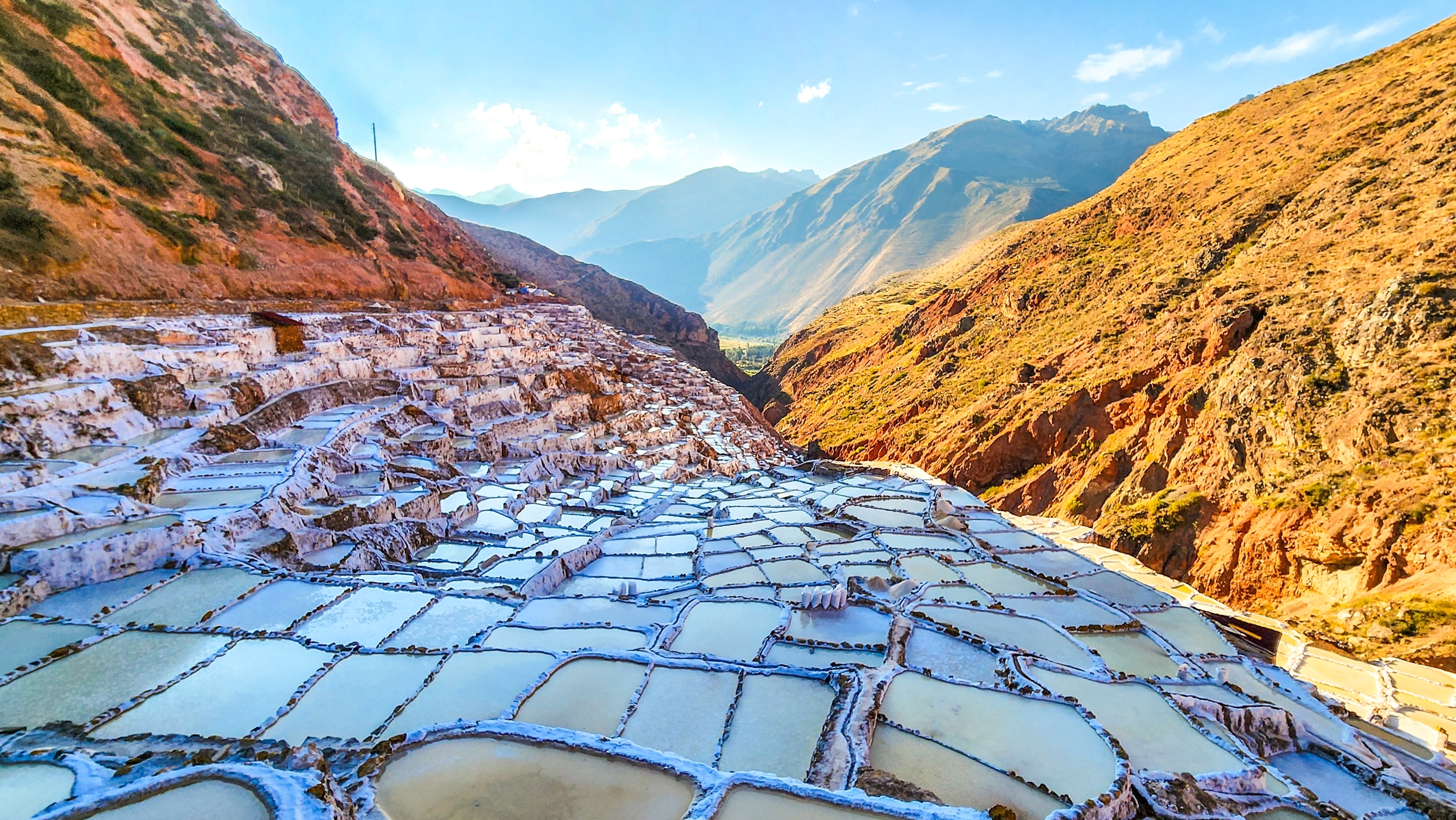
Maras Salt Mines (Salineras de Maras) - Climbing from the valley floor to the plateau above Urubamba, a steep winding road leads to one of the Sacred Valley's most visually stunning sites: over 5,000 salt evaporation ponds cascading down a hillside, fed by a natural salt spring. The terraced pools have been harvested since pre-Inca times and remain community-operated today. The geometric patterns of white, pink, and brown salt ponds against the green valley below create an extraordinary scene. Artisan salt is available for purchase.
Moray - On the plateau above Maras, these concentric circular terraces descending into natural depressions are believed to have been an Inca agricultural research station — an open-air laboratory where different altitudes and microclimates within each ring allowed experimentation with crop varieties. The largest depression drops 30 metres, creating temperature variations of up to 15°C between the top and bottom terraces. One of the most intellectually fascinating Inca sites.
Chinchero - The final stop before returning to Cusco, this highland town at 3,772 metres sits on a plateau with panoramic views of snow-capped mountains. The colonial church was built directly atop an Inca palace, and original Inca walls and niches remain visible. Chinchero is renowned for traditional textile weaving — community cooperatives demonstrate the entire process from shearing alpaca to natural dyeing with plants and insects (cochineal) to backstrap loom weaving. The Sunday market is excellent and far less touristy than Pisac's.
Driving Tips
- Acclimatise before driving: Cusco sits at 3,400 metres. Altitude sickness affects roughly 50% of visitors, causing headaches, dizziness, nausea, and impaired judgement — all dangerous behind the wheel. Spend 1-2 days acclimatising before driving. Better yet, descend into the Sacred Valley (2,800 m) on your first day and acclimatise at the lower altitude before returning to higher sites like Chinchero and Moray.
- Coca tea: Drink mate de coca (coca leaf tea), available everywhere, to ease altitude symptoms. Chewing coca leaves is also traditional and effective. Stay hydrated, avoid alcohol, and eat light meals.
- Road conditions: Main roads between Cusco, Pisac, Urubamba, and Ollantaytambo are paved and in good condition. Side roads to Maras, Moray, and Chinchero are steeper and occasionally rough. Watch for potholes everywhere and brutal speed bumps (lomadas) at every village entrance — they are severe and poorly marked.
- Boleto Turístico (Tourist Ticket): Purchase the Circuit 3 ticket (S/70) or the full Integral ticket (S/130) in Cusco before departing. It covers Pisac, Ollantaytambo, Chinchero, and Moray. Without it, you cannot enter these sites — you cannot pay at the gate for Moray.
- Maras Salt Mines: NOT included in the Boleto Turístico. Pay S/20 in cash (Peruvian soles only) at the entrance. No cards, no dollars.
- Fuel: Fill up in Cusco or Urubamba. Fuel stations are scarce in smaller towns. The full loop can be completed on a single tank, but don't chance it.
- Market days: Plan your route around market schedules. Pisac's Sunday market is the highlight; Chinchero's Sunday market is also excellent. Both are far larger and more vibrant than weekday versions.
- Sun protection: UV radiation at this altitude is extreme. Sunscreen, hat, and quality sunglasses are mandatory even on overcast days.
- Cash: Carry plenty of Peruvian soles. Many village shops, markets, and entrance gates accept cash only. ATMs exist in Cusco and Urubamba but are unreliable elsewhere.
- For more information visit: peru.travel