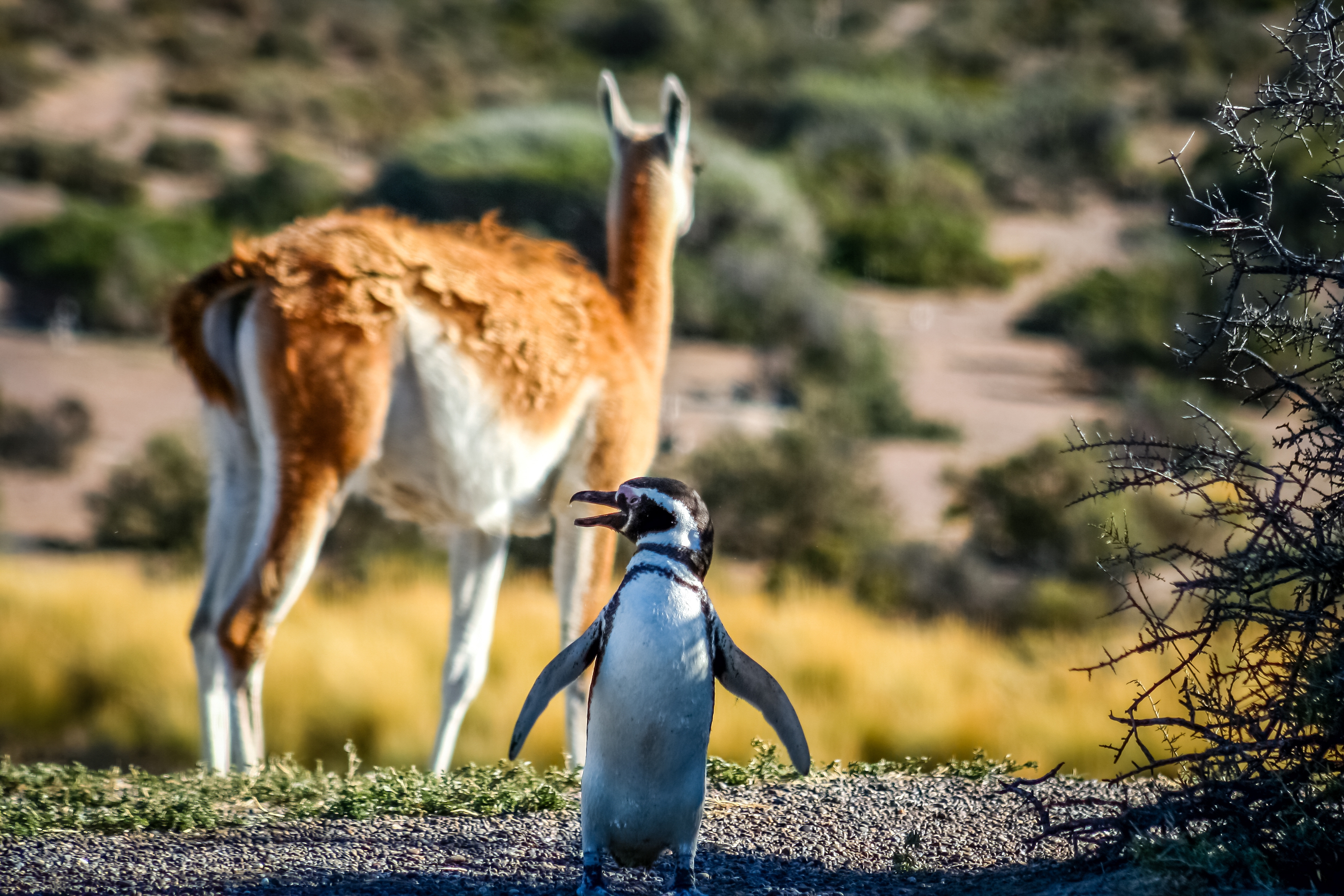
Penguin Highway

A Million Penguins on a Patagonian Shore
This daytrip south from Puerto Madryn leads to the largest continental colony of Magellanic penguins on Earth — up to a million birds nesting, breeding, and waddling in orderly processions between their burrows and the Atlantic. But the drive is far more than a wildlife excursion. It threads through the Chubut River valley, where the improbable story of Welsh Patagonia plays out in chapels, tea houses, irrigation canals, and a flour mill that still grinds grain — the legacy of 153 settlers who sailed from Liverpool aboard the clipper Mimosa in 1865 and carved a colony from the desert.
Heading south from Puerto Madryn on Ruta 3, the steppe opens wide and flat under an enormous sky. At Trelew — the valley's commercial hub, whose name is Welsh for "Town of Lewis" — a world-class paleontology museum houses the bones of the largest creature ever to walk the Earth. A short detour west along the Chubut River reaches Gaiman, a village of brick chapels and rose gardens where Welsh afternoon tea is served on lace tablecloths with torta negra, scones, and pots of strong brew. Further west, Dolavon's hand-dug irrigation canals and working flour mill tell the story of how the settlers turned arid steppe into wheat country.
East of Trelew, the provincial capital Rawson sits at the river mouth, its beach suburb Playa Unión the departure point for boat trips among Commerson's dolphins — small, striking black-and-white cetaceans that ride the bow wave within arm's reach.
South of the valley, the road narrows and the landscape empties. The final 22 km turn to gravel, running through scrubby steppe where guanacos and rheas watch from the roadside. Then, suddenly, the coast appears — and with it, penguins. Thousands upon thousands of them, stretching across the rocky headland in every direction, standing at their burrow entrances, shuffling along well-worn paths to the sea, feeding downy chicks, and ignoring you completely as you walk among them on boardwalk trails. Punta Tombo is not a zoo. It is a city — and the penguins are in charge.
Key Stops
Puerto Madryn The gateway city on the shore of Golfo Nuevo (pop. ~100,000). Before heading south, visit Punta Cuevas — the rocky headland where the Welsh settlers of the Mimosa first came ashore on 28 July 1865 and sheltered in caves carved into the cliff. The EcoCentro Pampa Azul on the seafront explains the marine ecosystem you are about to enter. Fill your tank and withdraw cash here — you will need both.
Trelew (km 67) The Chubut Valley's largest city, founded in 1886 when the railway arrived. The essential stop is the Museo Paleontológico Egidio Feruglio (MEF) — one of South America's finest paleontology museums. Its star exhibit is Patagotitan mayorum, the largest dinosaur ever discovered: an 80-tonne titanosaur that measured 40 m from nose to tail and stood as tall as a seven-storey building. Excavated in Chubut in 2014, its bones and a life-sized replica fill the gallery. A cast of the same skeleton stands in the American Museum of Natural History in New York.
Gaiman The cultural heart of Welsh Patagonia, 17 km west of Trelew along the Chubut River. A village of brick chapels, rose-covered cottages, and the famous Welsh tea houses — Ty Gwyn, Plas y Coed, and Ty Te Caerdydd, where Princess Diana took tea on 23 November 1995. All serve the traditional spread: homemade scones, lemon tart, banana cake, the dense Welsh torta negra (black cake), grilled spice biscuits, and pots of strong tea on embroidered tablecloths. Visit the Gaiman Welsh Museum in the old railway station, peer into Capel Bethel and Capel Salem, and walk the tree-lined streets where Welsh and Spanish mingle on shop signs. Each September the town hosts the Eisteddfod de la Juventud, a bilingual cultural festival of poetry, music, and bardic competition mirroring the ancient Welsh tradition.
Dolavon Nineteen kilometres further west, this quiet village preserves the engineering feat that saved the Welsh colony: the hand-dug irrigation canals that brought Chubut River water to the parched fields — Argentina's first artificial irrigation system. The 1881 flour mill still has its working water wheel; today it operates as a museum and restaurant (La Molienda), grinding flour that goes straight into the kitchen's own baking. A tangible link to the moment the colony turned from struggle to prosperity.
Rawson & Playa Unión Chubut's provincial capital, founded by the Welsh in 1865 as their first settlement (Yr Hen Amddiffynfa — "The Old Fortress"). The town itself is modest, but 6 km east at Playa Unión, boat trips depart from Puerto Rawson to see Commerson's dolphins (toninas overas) — small, exuberant black-and-white dolphins that play alongside the boats in the river mouth. One of the few reliable places in the world to encounter them. Trips last roughly 1.5 hours; best conditions in summer.
Punta Tombo A narrow, rocky headland jutting into the Atlantic, protected as a 210-hectare natural reserve. This is the largest continental Magellanic penguin colony in the world — between 500,000 and one million penguins during peak breeding season. A modern Interpretation Centre explains penguin biology and conservation, then a shuttle takes you to the colony itself.
Two trail options wind through the heart of the nesting area: a short 650 m loop and a longer 3.5 km circuit with boardwalks and observation platforms. Penguins are everywhere — standing sentry at burrow entrances, waddling in lines to the sea, regurgitating fish for fuzzy grey chicks, squabbling with neighbours, and crossing your path with absolute indifference to your presence. You walk among them at arm's length (though touching is strictly prohibited). The sight of tens of thousands of penguins stretching across the headland to the crashing surf is one of the great wildlife spectacles of the Southern Hemisphere.
Beyond the penguins, the reserve supports guanacos, Patagonian maras, armadillos, grey foxes, and birdlife including skuas, giant petrels, cormorants, steamer ducks, and Darwin's rheas on the approach roads. Over 180 bird species have been recorded.
Penguin Calendar
September Males arrive to reclaim burrows; females follow. Reserve opens
October Courtship, mating, egg-laying (2 eggs per clutch)
November Incubation: first chicks hatch late in the month
December Most chicks hatched; parents shuttle between burrows and sea
January Peak population, colony at maximum size. Best month for photography
February Juveniles fledging; first ventures into the ocean
March Adults and juveniles moulting; northward migration begins
April Colony thinning; reserve closes at month's end
Driving Tips
- Fill up in Puerto Madryn or Trelew. There are no fuel stations between Trelew and Punta Tombo, and none at the reserve.
- Bring cash in Argentine pesos. The reserve entry fee is cash only and there are no ATMs. Check current fees before departing — prices change frequently with inflation.
- Leave early. Depart Puerto Madryn by 7–8 AM to arrive before tour buses and enjoy the colony in soft morning light. The reserve opens at 8 AM.
- The final 22 km are gravel. Drive at 40 km/h or less. Keep distance from the vehicle ahead to avoid stone chips on your windscreen. A standard 2WD car handles it fine.
- Allow at least 2 hours at the colony. The long 3.5 km trail is worth the time — the further you walk, the fewer people and the more intimate the penguin encounters.
- Wear sturdy shoes and wind protection. Trails are sandy and rocky; Patagonian wind is relentless even on warm days. Sunscreen is essential — there is no shade.
- Watch for guanacos and rheas on the road, especially on the quiet RP 1 stretch approaching the reserve. They cross without warning.
- No mobile signal once you leave the towns. Download offline maps before departing.
- For more information visit: peninsulavaldes.com — Punta Tombo Ultimate Guide