Lake Michigan Tour
Michigan's West Coast: Dunes, Lighthouses, and the Tunnel of Trees
The 320-mile run from Saugatuck to Mackinaw City along Michigan's western shore is the most varied and beautiful stretch of Great Lakes coastline in America: art colonies tucked into dune valleys, the Dutch heritage city of Holland, working harbor towns lit by red pierhead lighthouses, the world's largest collection of freshwater sand dunes at Sleeping Bear Dunes National Lakeshore, the Cherry Capital of Traverse City surrounded by 75 percent of America's tart cherry crop and the country's premier cool-climate Riesling region, the storybook resort towns of Charlevoix and Petoskey on Little Traverse Bay, the famous Tunnel of Trees scenic byway (M-119) where overhanging oaks form a 20-mile canopy above the lake, and finally Mackinaw City at the foot of the Mackinac Bridge, where Lake Michigan meets Lake Huron at the Straits of Mackinac. The shoreline was shaped by Pleistocene glaciers about 12,000 years ago and finished by post-glacial winds that piled sand into dunes up to 450 feet tall. The corridor was the heart of New France's fur trade after 1670, supporting Catholic missions at Mackinac (1671) and Native villages of the Odawa, Ojibwe, and Potawatomi peoples for at least 5,000 years before that. The 19th century brought lumber barons, steamships, and the railroad; the 20th brought summer resorts, the Tunnel of Trees, and the Mackinac Bridge (1957, the third-longest suspension bridge in the world at the time of opening). The route still feels like Michigan's classic summer pilgrimage: family cottages, sand on the floorboards, smoked whitefish dinners, and the smell of cherry blossoms in May and apple cider in October.
Key Stops
Saugatuck and Douglas (Start) The artsy twin Michigan resort towns of Saugatuck and Douglas anchor southwest Michigan's premier coastal art colony. Founded in the 1830s and rebuilt as an artists' refuge in the early 20th century, Saugatuck has 100+ art galleries, a downtown of restored Victorian buildings, Oval Beach (often ranked among America's best Lake Michigan beaches), the Saugatuck Chain Ferry (a hand-pulled chain ferry across the Kalamazoo River, operating since 1838). Mt. Baldhead offers panoramic views via a 302-step climb. The Saugatuck Dunes State Park preserves 2.5 miles of undeveloped beach and dune.
Holland A short drive north, Holland was founded in 1847 by Dutch Calvinist immigrants and remains the most thoroughly Dutch-American town in the United States. The annual Tulip Time Festival in early May draws over 500,000 visitors to see 5 million tulips planted around the city. Other Dutch heritage sites: Windmill Island Gardens (with the working 250-year-old "De Zwaan" windmill, shipped from the Netherlands in 1964; the only authentic Dutch windmill in operation in the United States), Dutch Village theme park, and a downtown of brick storefronts with classic Dutch trompe l'oeil. Holland State Park features the iconic red Holland Harbor Lighthouse ("Big Red"), one of the most photographed lighthouses in Michigan.
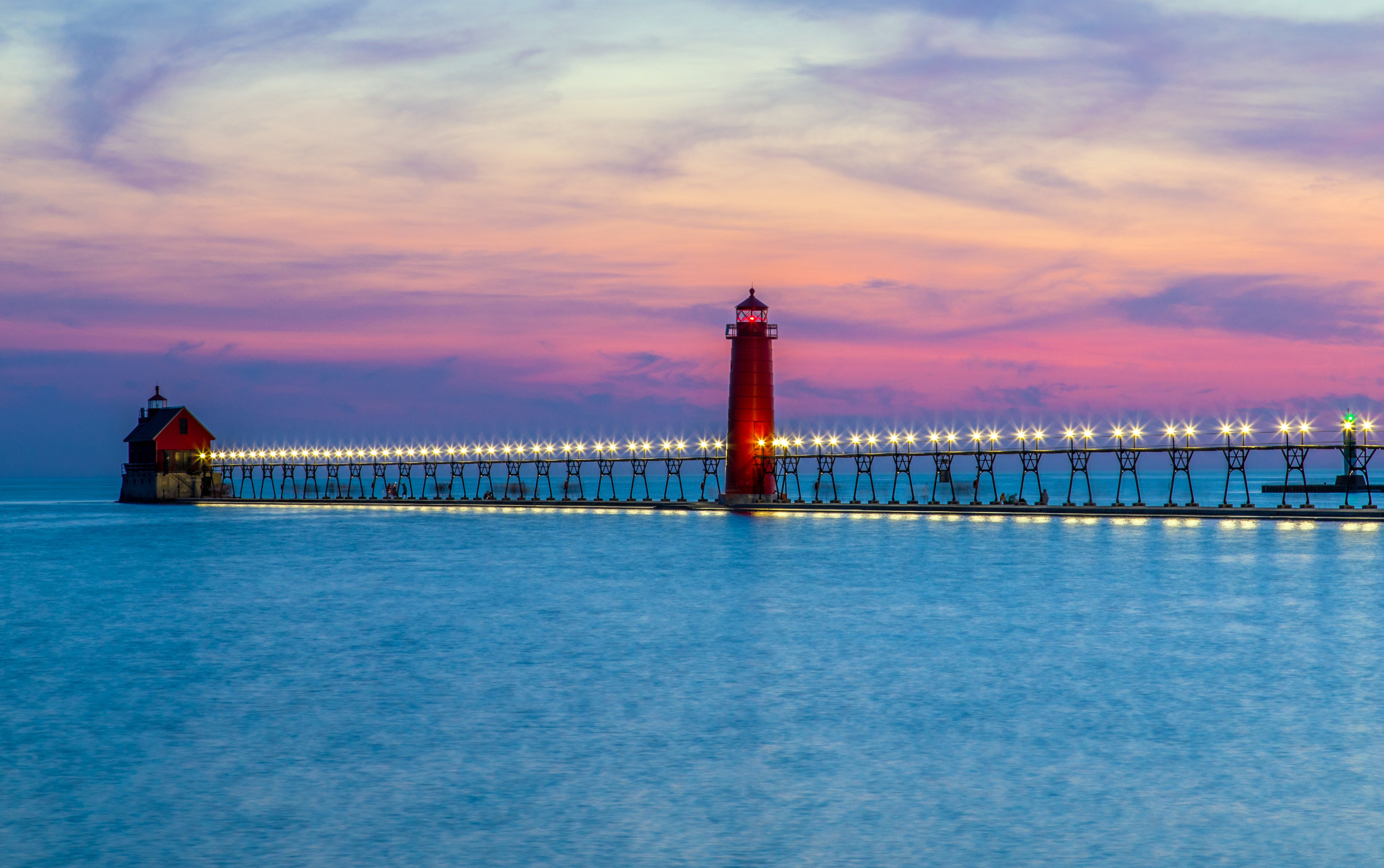
Grand Haven A historic Lake Michigan harbor town with the iconic red Grand Haven Pierhead Lighthouse. The Grand Haven Musical Fountain on the Grand River performs nightly choreographed light-and-water shows in summer (the world's largest musical fountain when built in 1962). The boardwalk along the river leads to the lighthouse. Grand Haven State Park has 48 acres of beach and a lighthouse.
Muskegon A former lumber boomtown with several preserved Victorian mansions, including the Hackley & Hume Historic Site (two 19th-century lumber-baron mansions adjacent to each other). Muskegon State Park and PJ Hoffmaster State Park (with the Gillette Sand Dune Visitor Center) preserve dunes and beaches. The USS Silversides Submarine Museum displays a WWII submarine in the harbor.
Ludington The eastern terminus of the SS Badger, the last operating coal-fired passenger steamship in the United States (a 4-hour crossing to Manitowoc, Wisconsin; operates May through October; carries passengers and vehicles). The Big Sable Point Lighthouse in Ludington State Park is reached by a 1.8-mile beach walk. The park preserves 5,300 acres of dunes, beaches, and forests. The downtown has a thriving Stearns Park beach.
Frankfort and Point Betsie Lighthouse Frankfort sits at the mouth of the Betsie River with a long pierhead lighthouse and an excellent beach. Just north on the way to Sleeping Bear is Point Betsie Lighthouse (1858), one of the most photographed lighthouses on the Great Lakes. The lighthouse keeper's quarters operates as a museum.
Sleeping Bear Dunes National Lakeshore The drive's natural centerpiece: 65 miles of Lake Michigan shoreline preserving the world's largest collection of freshwater sand dunes. Dunes rise 450 feet above the lake at the Sleeping Bear Plateau. Key experiences:
- Pierce Stocking Scenic Drive, a 7.4-mile one-way loop with 12 numbered stops, including the famous Lake Michigan Overlook (450 feet straight down to the water; do not climb down unless you're prepared for a brutal 1-hour climb back up)
- Dune Climb, a 110-foot-tall sand wall climbed by hundreds of thousands of visitors a year
- North and South Manitou Islands, reached by passenger ferry from Leland
- Empire Bluff Trail, Pyramid Point Trail, and Sleeping Bear Point Trail
Voted "Most Beautiful Place in America" by ABC's Good Morning America (2011). Park entry $25 per vehicle. The Philip A. Hart Visitor Center in Empire provides orientation and exhibits.
Glen Arbor and M-22 The village of Glen Arbor sits in the heart of Sleeping Bear country with shops, restaurants, and views of Glen Lake (often called one of America's most beautiful lakes for its turquoise color). M-22 north of Glen Arbor is one of America's most scenic drives, hugging the Lake Michigan coast through forest, dunes, and orchards. The "M-22" road-sign logo has become a regional brand and is sold on merchandise throughout the state.
Leland and Fishtown A picturesque historic fishing village with weathered wooden shanties lining the Leland River. Fishtown's original commercial fishing buildings are preserved as working shops, restaurants, and fish-smoking sheds (the smokehouses still produce smoked whitefish for sale). Ferries to South and North Manitou Islands depart from here. Stop for a smoked whitefish lunch at Carlson's or a meal at the historic Bluebird restaurant.
Traverse City and Old Mission Peninsula The largest city in northern Michigan (population approximately 16,000) and the self-proclaimed "Cherry Capital of the World." The surrounding region produces about 75 percent of America's tart cherry crop. The National Cherry Festival in early July draws 500,000 visitors. The city sits on Grand Traverse Bay with two long peninsulas extending north. Old Mission Peninsula, a narrow 18-mile finger, has 17 wineries (including Chateau Grand Traverse, Black Star Farms, and Brys Estate), cherry orchards, and the Mission Point Lighthouse at the 45th parallel (exactly halfway between the equator and the North Pole). Old Mission Peninsula AVA produces some of the country's finest Rieslings. Front Street downtown has been beautifully restored, with the historic State Theatre (renovated by Traverse City native Michael Moore, who runs the Traverse City Film Festival here in late July), excellent restaurants, breweries, and shops. Full services and excellent lodging.
Elk Rapids and Torch Lake Northeast of Traverse City, Elk Rapids is a small village on Lake Michigan with a beautifully preserved 1800s downtown. Inland, Torch Lake (Michigan's longest inland lake at 19 miles) is famous for its Caribbean-turquoise color, the result of glacial flour suspended in the meltwater. The Torch Lake "sandbar" at the south end is a popular summer boating destination.
Charlevoix A refined northern Michigan resort town famous for the "Mushroom Houses" designed by Earl Young in the 1920s through 1950s (whimsical stone houses with curving roofs of wavy cedar shakes, hidden in residential neighborhoods; free to view from the street with self-guided maps available at the visitor center). The Pine River Channel has a working drawbridge that opens for sailboats, and the Victorian downtown extends from Round Lake to the bay. Ferries to Beaver Island (Michigan's largest island, with a quirky history as a former Mormon kingdom in the 1850s) depart from Charlevoix.
Petoskey Famous for Petoskey stones (fossil coral from the Devonian period, the Michigan state stone, found on local beaches especially after spring storms), the Gaslight District with restored brick storefronts, and Bay View (a National Historic Landmark community of 440 Victorian "cottages" originally built as a 19th-century Methodist Chautauqua resort). Stafford's Perry Hotel (1899) and the Stafford's Bay View Inn are historic landmarks. The downtown overlooks Little Traverse Bay with sweeping water views.
Harbor Springs A small, exclusive resort town across Little Traverse Bay from Petoskey, with elegant downtown shopping, waterfront mansions, and one of the most beautiful natural harbors on the Great Lakes. The town's wealthy summer residents have preserved the village's quiet historic character; no chain stores or fast food in the downtown. The Andrew Blackbird Museum tells the story of the Odawa community here.
Tunnel of Trees (M-119) The 20-mile Tunnel of Trees from Harbor Springs to Cross Village is one of America's most distinctive scenic drives: a narrow two-lane road winding through a canopy of overhanging hardwoods (sugar maple, beech, white birch, and yellow birch) so dense that the road becomes a green tunnel in summer and an orange-and-gold tunnel in fall. The road perches on a high bluff above Lake Michigan with frequent water views through the trees. No center line, no shoulders, and a 35-mph speed limit are required by the dense canopy and tight curves. Spectacular in mid-October during peak foliage. Several small art galleries, a Catholic mission church (Holy Cross at Cross Village, 1855), and Pond Hill Farm are highlights along the way.
Cross Village The Tunnel of Trees terminates at this tiny lakeside village with the legendary Legs Inn, a famously eccentric Polish-American restaurant built in the 1920s and 1930s by Stanley Smolak from driftwood, fieldstone, and tree roots. The interior walls are covered in carved totems and Native American-style artifacts. The restaurant serves authentic Polish food (pierogi, golabki, hunter's stew) and has a sweeping lakefront patio that catches summer sunsets. Open mid-May to mid-October. A genuine American original.
Mackinaw City (End) The drive's northern terminus and one of Michigan's iconic gateway towns. Key sites:
- Colonial Michilimackinac State Park, a reconstructed 1715 French fur-trading fort with costumed interpreters, archeological excavations, and a museum (entry approximately $14 per adult)
- Old Mackinac Point Lighthouse (1892, in a Norman-château style)
- Historic Mill Creek Discovery Park (a working sawmill recreation)
- Mackinac Bridge Museum (free, in the Mama Mia restaurant; documents the construction of the 5-mile suspension bridge across the Straits of Mackinac)
- Ferry services to Mackinac Island (no automobiles allowed on the island; horse, bicycle, and walking only; home of the Grand Hotel with the world's longest porch at 660 feet, Fort Mackinac, and Victorian charm preserved since 1898). Ferry crossing takes about 30 minutes; allow at least a half day on the island, ideally an overnight.
Mackinaw City has many fudge shops (over 10,000 pounds of Mackinac fudge are made daily across the region), restaurants, motels, and the Mackinac Bridge towers visible from town.
Driving Tips
- Allow 4 to 5 days to drive the route with stops. Major overnight bases: Saugatuck/Holland (1 night), Sleeping Bear Dunes area or Traverse City (2 nights), Petoskey/Harbor Springs (1 night), Mackinaw City or Mackinac Island (1 night).
- Direction: South to north (Saugatuck to Mackinaw City) builds the drive toward the dramatic finale at the Mackinac Bridge. The reverse works for travelers continuing south from the UP.
- Sleeping Bear Dunes entry is $25 per vehicle (7 days). Park crowds peak July–August; visit weekdays or early morning for parking at popular stops. The Pierce Stocking Scenic Drive can have long entry lines in peak summer.
- Holland's Tulip Time Festival (early May) sells out lodging months in advance. Visit late April for early blooms with fewer crowds.
- Traverse City lodging fills well in advance for the National Cherry Festival (early July), Traverse City Film Festival (late July), and peak fall foliage weekends.
- Mackinac Island has no cars. Ferry parking at Mackinaw City fills early on summer weekends. Plan to leave your vehicle and overnight on the island for the full experience; book Grand Hotel or other island lodging months in advance.
- The Tunnel of Trees (M-119) is narrow with no center line, no shoulders, and a 35-mph speed limit. RVs and trailers should consider an alternate route via US-31 to Mackinaw City. Spectacular in fall but very crowded; drive midweek if possible.
- M-22 between Glen Arbor and Leland is also one of America's most scenic drives. Drive slowly and use pullouts.
- Beach safety: Lake Michigan can be dangerously rough with sudden waves and rip currents, especially during fall storms. Respect posted warnings; rip currents cause fatalities here every year.
- Cell coverage is reliable along most of the route but spotty along M-22 north of Empire and on the Tunnel of Trees. Download offline maps.
- Fall foliage peaks late September to mid-October in northern Michigan, mid-to-late October in southern Michigan. The drive is spectacular at peak.
- Cherry season runs July (tart cherries) to early August (sweet cherries). U-pick farms and roadside stands operate throughout the Leelanau and Old Mission peninsulas. Wine-tasting is available year-round at most wineries; reserve in advance for groups.
- The SS Badger ferry at Ludington can shortcut to Wisconsin if you want to add Door County to the trip. Reservations recommended.
- For more information visit: West Michigan Tourist Association