Curonian Spit
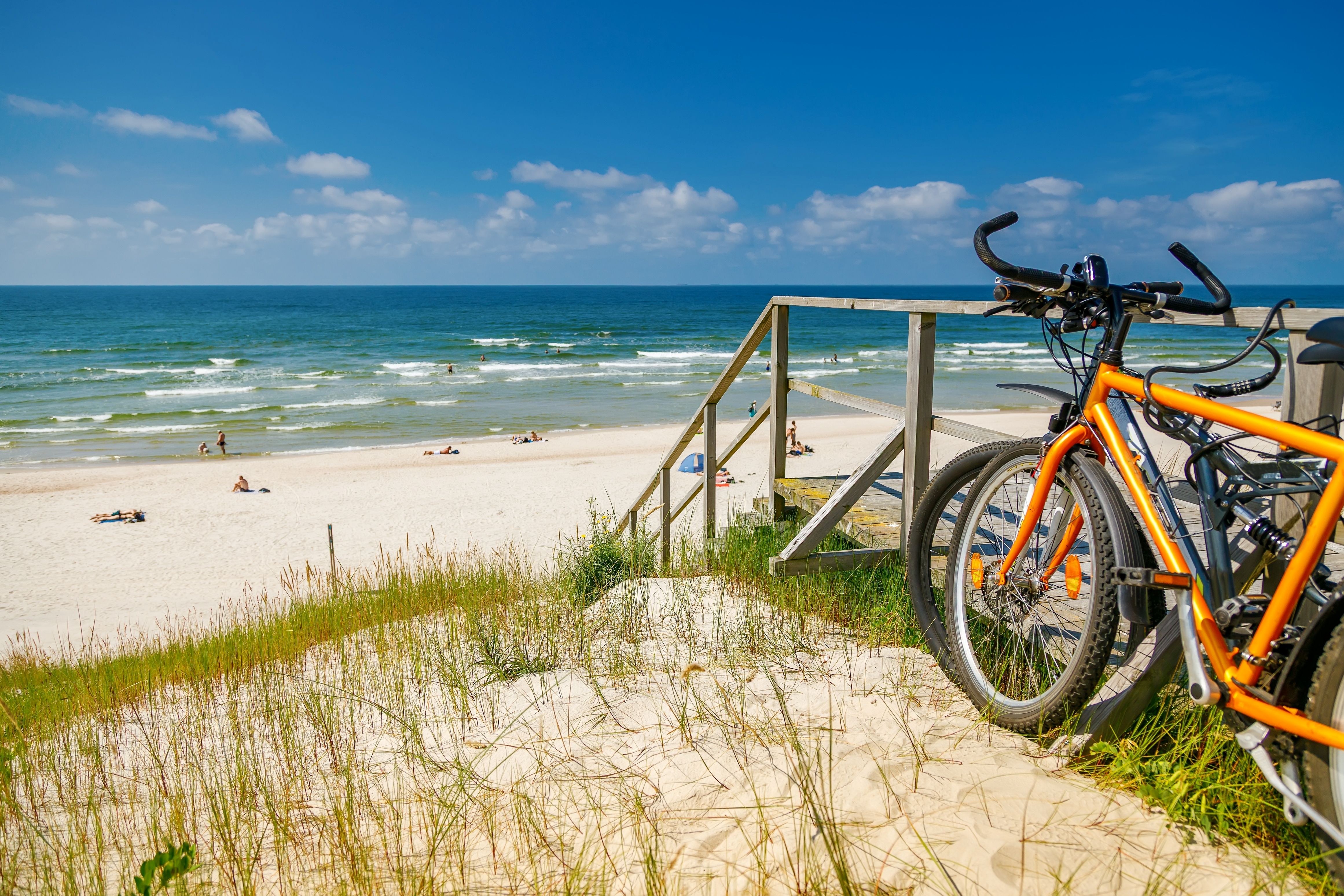
A Road Down a Ribbon of Sand Between Lagoon and Sea
The Curonian Spit is a 98 km arc of sand separating the freshwater Curonian Lagoon from the Baltic Sea, nowhere more than a few kilometers wide, crowned by some of the highest moving dunes in Europe and listed in its entirety as a UNESCO World Heritage cultural landscape. Lithuania owns the northern half, and one quiet road runs down it: onto the ferry at Klaipėda, off at Smiltynė, then 50 km south through pine forest to the resort village of Nida near the Russian border, where the asphalt effectively ends. The landscape is the story here. After 18th-century deforestation set the dunes marching, sand buried more than a dozen villages, and the forests you drive through today are a hand-planted 19th-century rescue project that UNESCO honors as much as the nature itself. The result is a drive of strange, soft beauty: an unbroken corridor of pines with the sea hushing on one side, the lagoon glittering on the other, and at the end a Sahara-like dunescape you climb on foot beside a village of blue-and-brown wooden cottages that once housed fishermen and, for a few summers, Thomas Mann.
Key Stops
Klaipėda. Lithuania's port city and the launch point. Its compact old town of half-timbered warehouses and the Theatre Square area are worth a wander before you queue for the ferry; this is also the place to fill the tank and pick up supplies.
Smiltynė. First stop off the ferry: the Lithuanian Sea Museum, housed in a 19th-century moated fort at the spit's northern tip, with its aquarium and dolphinarium making it the country's favorite family attraction. Clean Baltic beaches run behind the dunes within a short walk.
Juodkrantė. The spit's second village, strung along the lagoon with a sculpture-lined promenade. On the forested hill above winds the Hill of Witches, a trail of nearly a hundred carved wooden devils, witches, and folk-tale figures, free and gloriously odd. Just south of the village, watch and listen for one of Europe's largest colonies of grey herons and great cormorants, thousands of birds nesting in the pines beside a signed viewpoint. Juodkrantė's Amber Bay recalls the 19th-century amber dredging that made the village briefly rich.
The Dead Dunes of Nagliai. Midway down the spit, a boardwalk trail leads into the Nagliai Nature Reserve, a bare, grey dunescape of ridges and hollows where four villages lie buried under the sand that overran them. The silence and the sculpted, lichen-crusted slopes make this the eeriest and most moving stop on the drive. Walking is allowed only on the marked trail.
Pervalka and Preila. The spit's two smallest villages, both founded by families displaced by the moving sand. Little happens in either, which is the point: quiet lagoon-side piers, reed beds, and a handful of fish smokehouses. Near Preila rises Vecekrugas, the spit's highest dune, topped by a viewpoint reached on a short forest trail.
Nida. The finale and the place to sleep: a former fishing village turned genteel resort, its lanes lined with reed-thatched cottages in the traditional blue, brown, and white, ridge-poles carved into ornate weathervanes. See the Thomas Mann summer house on its hill (the novelist summered here in 1930 to 1932 and its museum tells the story), the red-brick lighthouse, the amber gallery, and the lagoon promenade with its fleet of flat-bottomed kurėnas sailboats.
Parnidis Dune. Walk (never drive or scramble off-trail) from Nida up the great 50-meter dune south of the village, crowned by a granite sundial-calendar. From the top, waves of white sand roll away toward the Russian half of the spit, and this is the one place in Lithuania where you can watch the sun both rise from water and set into it. Sunset here is the drive's closing scene.
Driving Tips
The ferry and park toll are the price of entry. Cars cross on the frequent ferry from Klaipėda's New Ferry Terminal, and an ecological toll is collected at the Alksnynė checkpoint on the spit road, with higher rates in peak season. Published prices vary and change; check the ferry operator and Neringa municipality sites for current fares before you go.
Stay off the open dunes. The dunes are the most fragile landscape in Lithuania, and every footprint outside the marked boardwalks and trails erodes them (rangers do fine offenders). The rule makes the experience: the trails at Nagliai and Parnidis are superb.
Expect low speed limits, strictly kept. The single road is smooth but modestly limited, dropping hard through the villages, and enforcement is routine. Elk and wild boar wander out of the pines, especially at dawn and dusk, so the limits are also self-preservation.
Fill up in Klaipėda. Fuel on the spit is scarce and pricier; start with a full tank and the whole trip is covered.
Fire rules are absolute. The spit is one continuous pine forest on sand, tinder-dry in summer. No open fires, no wild camping, and in drought periods even forest entry can be restricted; heed the posted warnings.
The road ends at a hard border. Beyond Nida the spit continues into Russia's Kaliningrad region, and the crossing has in recent years been effectively closed to most travelers. Treat Nida as the terminus, keep documents handy near the border zone, and don't fly drones there.
Come shoulder-season for the magic. May, June, and September give warm light, open hotels, and empty dunes. After autumn storms, locals comb the Baltic beaches for amber, and joining them is a genuine local experience.
Pair it with the Panemunė Castles Road. The two drives chain naturally: follow the Nemunas castles west to the delta, then finish on the spit for a castles-to-dunes route across western Lithuania.
For more information visit: Lithuania Travel: Curonian Spit, a Kingdom of Water, Sand, and Wind