17-Mile Drive
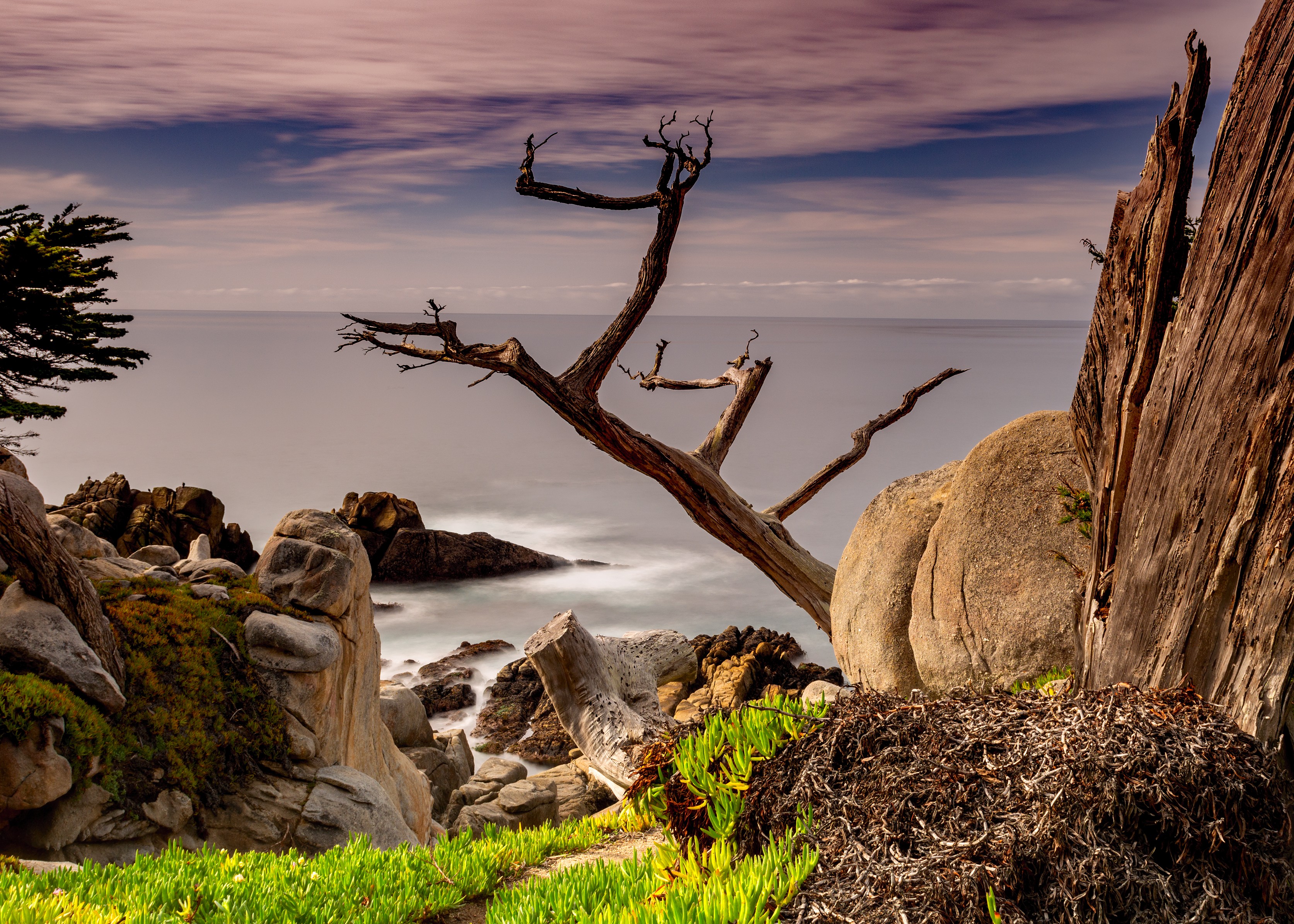
A Lone Cypress on the Edge of the World
First established in 1881 as a horse-drawn carriage route for guests of the Hotel Del Monte, 17-Mile Drive loops through the Del Monte Forest and along the Pacific coastline of the Monterey Peninsula — past wind-gnarled Monterey cypresses that grow naturally in only two places on Earth, three of the world's most storied golf courses, 1920s mansions, harbour seal rookeries, and the Lone Cypress, a 250-year-old tree clinging to a wave-lashed granite pedestal that has become the symbol of the California coast. A fold-out map marking 17 numbered stops is handed to you at the tollgate. Enter at the Pacific Grove Gate and drive clockwise to keep the ocean on your right; finish the loop as the sun drops and a lone bagpiper — a nightly tradition since 1987 — walks the Scottish-style links at Spanish Bay playing into the sunset.
Key Stops
Spanish Bay & The Inn at Spanish Bay A broad white-sand beach backed by dunes and coastal scrub, with boardwalk access to the shore. The Inn at Spanish Bay opened in 1987 alongside The Links at Spanish Bay, a Scottish-style course designed by Robert Trent Jones Jr., Sandy Tatum, and Tom Watson. It was Watson who, surveying the landscape, remarked: "Spanish Bay is so much like Scotland, you can almost hear the bagpipes." The resort took him literally. Every evening since opening night — rain or shine, every day of the year — a lone bagpiper walks the links at sunset, beginning on the first tee and finishing 45 minutes later at the fire pits near the second green. A rotation of six pipers performs nightly; two of them have been playing since 1987. During Daylight Saving Time, the performance begins around 5:45 PM; during Standard Time, half an hour before sunset.
Point Joe A large rocky outcropping where seven ocean currents collide, creating violently churning, unpredictable seas. Early mariners mistook Point Joe for the entrance to Monterey Bay and set courses directly for these rocks — resulting in numerous shipwrecks over the centuries. The name comes from a man named Joe who lived in a driftwood hut here in the early 1900s, selling trinkets to tourists and tending goats.
China Rock A rugged stretch of shoreline that was once the site of a Chinese fishing village from roughly 1850 to 1912. Chinese fishermen built lean-to shelters against the rocks, harvested abalone at low tide, dried and processed them in shoreside camps, and shipped them in hundred-pound bales to San Francisco and onward to China. Century-old cooking smoke is still blackened onto the rocks — a ghostly trace of a vanished community.
Bird Rock A large offshore rock formation teeming with harbour seals, California sea lions, brown pelicans, Brandt's cormorants, and gulls. Until 1930, the rock was covered in 4–5 feet of pelican and cormorant guano, which was harvested as fertiliser. Once cleaned off, sea lions moved in and have been sunbathing there ever since. From the viewing area, sea otters are frequently visible floating in the kelp beds, and from November through March, migrating gray whales can be spotted passing offshore.
Fanshell Beach A beautiful crescent beach that serves as an important harbour seal pupping ground. From March through June, the beach is fenced off with privacy barriers to protect mother seals and their newborn pups from disturbance. Outside pupping season, it is one of the prettiest stretches of sand on the drive.
Cypress Point Lookout One of the most panoramic viewpoints on the entire drive — sweeping southwest-facing views of the Pacific, dramatic coastal cliffs, and the rugged shoreline stretching toward Point Lobos. A large parking area makes this an easy stop. From November through March, it is the prime whale-watching vantage point on 17-Mile Drive: look for the spouts and flukes of migrating gray whales. Humpback whales are possible March–November; blue whales July–October.
Crocker Grove Named after railroad baron Charles Crocker, who built the Hotel Del Monte and the original 17-Mile Drive in 1881. This grove contains some of the oldest and largest Monterey cypress trees in existence — specimens over 300 years old. Monterey cypress grows naturally in only two places on the entire planet: here at Cypress Point and across Carmel Bay at Point Lobos State Natural Reserve. The trees' gnarled, wind-sculpted forms are shaped by lifetimes of salt spray, fog, and Pacific wind. A fence protects the grove; visitors view the ancient trees from a short distance.
The Lone Cypress The single most iconic image of the Monterey Peninsula and one of the most photographed trees in the world. This salt-pruned Monterey cypress has clung to its wave-lashed granite pedestal for an estimated 250 years, having sprouted around the 1770s — before the founding of the United States. Pebble Beach founder Samuel F.B. Morse selected it as the company's trademark in 1919, seeing in it "the solidity of the rock, vaguely reminiscent of Gibraltar, yet with the life of a rugged tree clinging with tenacity above the power of the ocean." The Los Angeles Times described it as "to the Monterey Peninsula what the pyramids are to Egypt, what the Eiffel Tower is to Paris." Centuries of wind, salt spray, and storms have taken their toll — the tree is now supported by cable stays and a stone retaining wall, with fencing protecting the exposed root system — but it endures, a symbol of persistence against the Pacific.
The Ghost Tree At Pescadero Point, dead and dying Monterey cypresses stand bleached bone-white by decades of wind, sun, and salt spray, giving them an eerie, spectral appearance. The name was coined by Carmel surfer Don Curry. Offshore lies one of the most dangerous big-wave surfing breaks in the world — the deep Carmel Submarine Canyon focuses rare winter swells into waves of up to 60 feet (18 m), breaking over a treacherous reef of rock pillars, bull kelp, and massive boils.
Pebble Beach Golf Links Opened 22 February 1919, designed by Jack Neville and Douglas Grant, and consistently ranked among the top public golf courses in the world. Its clifftop holes along Stillwater Cove and Carmel Bay are among the most famous in golf. Pebble Beach has hosted six U.S. Open Championships — 1972 (Jack Nicklaus), 1982 (Tom Watson's legendary chip-in at 17), 2000 (Tiger Woods' record 12-under), 2010, 2019, with a seventh scheduled for 2027 — plus the first-ever U.S. Women's Open at Pebble Beach in 2023. The annual AT&T Pebble Beach Pro-Am, descended from Bing Crosby's 1930s charity "Clambake," pairs professionals with celebrities and amateurs each February.
Stillwater Cove A peaceful, sheltered cove near The Lodge at Pebble Beach, with a picturesque pier and calm waters rich with undisturbed marine life. Sea otters and harbour seals are frequently spotted in the kelp forests. The beach is open for public use during daylight hours.
Driving Tips
- Enter at the Pacific Grove Gate and drive clockwise. This keeps the ocean on your right for unobstructed views and the easiest access to pullouts. A fold-out map of all 17 stops is provided at the gate.
- Toll is $12.25 per vehicle. Credit cards accepted; cash recommended as backup. The fee is reimbursed if you spend $35 or more dining at any Pebble Beach Resorts restaurant (keep your receipt).
- Motorcycles are entirely prohibited. Bicyclists and pedestrians enter free.
- Speed limit is 25 mph (15–35 mph in different zones). The road is residential and winding — drive slowly and watch for deer, which are common throughout the Del Monte Forest.
- Arrive early on weekends. Pullouts at the Lone Cypress and Bixby Bridge area fill by mid-morning in peak season. Weekday mornings shortly after sunrise offer the quietest experience.
- Stay for the sunset bagpiper at Spanish Bay. Time your drive to finish at the Inn at Spanish Bay as the sun drops. The performance is unforgettable — and it happens every single evening, year-round.
- Fanshell Beach is fenced March–June to protect harbour seal pups. Do not approach or disturb marine mammals anywhere on the drive.
- Event closures. During the AT&T Pro-Am (February), Concours d'Elegance (August), and U.S. Open (June), portions of the route may be restricted and traffic is heavier. Check the Pebble Beach website before visiting.
- Whale-watching season runs November–April from Cypress Point Lookout and Bird Rock. Bring binoculars.
- Carry a jacket. Even on warm days, Pacific fog and wind can make the coastal stops significantly cooler than inland.
- For more information visit: pebblebeach.com/17-mile-drive